

Why Are AGM Procedures Central to Responsible Condominium Governance?
In strata-titled residential developments, the Annual General Meeting, or AGM, is one of the most important governance events of the year. It is the formal platform where subsidiary proprietors review how the common property has been managed, examine the estate’s financial position, and take part in decisions that shape the development’s operations for the year ahead.
Through the AGM, proprietors exercise their collective authority on key matters such as approving financial statements, adopting the budget for the coming financial year, and electing council members to oversee estate management. These decisions affect not only the estate’s finances but also the daily living environment, maintenance priorities, and long-term upkeep of the condominium.
Because the AGM involves formal decision-making, it must follow clearly defined steps. These help ensure that proprietors receive proper notice, discussions stay organised, and voting outcomes reflect the decisions of those entitled to participate.
When AGM procedures are carried out properly, they help proprietors see how decisions are made, how estate funds are used, and how approved priorities will be followed through. Council members can also carry out their duties with better records, clearer owner feedback, and a stronger basis for planning the coming year.
Conversely, poorly administered meetings may lead to disputes, confusion over voting outcomes, delays in implementing important estate decisions, or questions about whether decisions were made correctly. In a Singapore condominium setting, where many owners may have different expectations, investment interests, and levels of involvement, a well-run AGM helps keep decision-making orderly and fair.
Key Takeaways
- The Annual General Meeting gives subsidiary proprietors a formal way to review financial matters, elect council members, and make decisions that affect the shared estate.
- Careful preparation before the meeting helps reduce confusion when notices, agendas, accounts, proxy forms, ownership records, and voting details are properly organised.
- Clear communication during the meeting helps proprietors understand proposed decisions, raise questions, and follow the discussion in an orderly manner.
- Proper documentation after the meeting helps councils record approved decisions, maintain accountability, and support smoother estate operations throughout the year.
Understanding AGM Procedures in Condominium Estates

Before looking at the meeting steps in detail, it is helpful to understand why the AGM carries such weight in a Singapore condominium. For MCST councils, managing agents, and subsidiary proprietors, the AGM is where financial accountability, estate planning, council representation, and owner participation come together in one formal setting.
The Governance Role of the Annual General Meeting in MCST Operations
The Annual General Meeting functions as the principal governance forum for the Management Corporation Strata Title, or MCST. Through this meeting, subsidiary proprietors review the estate’s management, examine financial matters, elect council members, and vote on decisions affecting common property.
Financial statements and proposed budgets allow proprietors to understand how estate funds have been used and what costs may be expected in the year ahead. Council elections also determine who will help oversee maintenance priorities, contractor matters, compliance issues, and owner communication.
The meeting may also address resolutions involving common property, estate policies, shared facilities, security systems, façade works, landscaping, or other operational matters. Because these decisions affect daily living and long-term estate upkeep, AGM procedures should help owners understand the proposal, voting basis, cost, impact, and next steps.
Regulatory Framework Governing AGM Procedures
In Singapore, the AGM is not treated as a casual estate meeting. It sits within a regulatory framework that guides how MCSTs convene meetings, notify proprietors, establish quorum, manage voting, and document decisions. These requirements help ensure that major decisions affecting common property are made transparently and through a recognised process.
AGM procedures are governed by statutory requirements established under the Building (Strata Management) Act 2004, formerly known as the Building Maintenance and Strata Management Act, or BMSMA. This updated reference is important because many industry practitioners may still recognise the former name, while the current legal title should be used for accuracy. The legislation sets out how MCSTs must conduct general meetings so that decisions affecting common property are made through a proper governance framework.
It also sets out timing requirements for AGMs, which must generally be held once in every calendar year and no more than 15 months after the previous AGM. This keeps financial review, council accountability, and estate decision-making on a regular cycle.
Notice Requirements
A formal notice must be issued to subsidiary proprietors before the AGM is convened. The notice should state the meeting’s date, time, venue, agenda, proposed resolutions, voting rights, and council election details where relevant.
For an AGM, the notice should also be accompanied by the statement of accounts, the auditor’s report, and a motion for the adoption of those accounts. This allows proprietors to review the estate’s financial position before the meeting instead of relying only on verbal explanations during the session.
Notice periods depend on the type of meeting and motion being proposed. Under Singapore strata management requirements, AGM notices and certain motions generally require longer notice than routine meeting matters. Clear notices are an important part of condominium governance procedures because they give proprietors enough context to understand what is being proposed before the meeting. A managing agent can also assist the council by advising on notice requirements, supporting document preparation, and helping ensure that proprietors receive the relevant information clearly and on time. When motions are unclear or supporting information is incomplete, discussions may be delayed, votes may be questioned, and approvals may not reflect fully informed participation.
Quorum Requirements
For decisions made during the AGM to be valid, the meeting must satisfy quorum requirements. In practice, quorum is determined by share value rather than by headcount alone. Singapore strata guidance provides that an AGM quorum is generally formed when those present in person or by proxy together hold the required share value threshold.
This makes quorum requirements for an AGM a practical issue that councils and administrative teams should check before the meeting moves into formal business. If a meeting is convened by the MCST and quorum is not present within 30 minutes of the scheduled start time, the meeting may proceed as if quorum were present only where the applicable requirements are met. For general meetings not convened on a requisition by subsidiary proprietors, this generally requires at least two subsidiary proprietors to be present in person.
The 30-minute rule does not apply to an extraordinary general meeting requisitioned by subsidiary proprietors, where the quorum must be met in full before the meeting can proceed.
Voting Procedures and Resolution Types
The AGM may consider different categories of resolutions depending on the nature of the decision involved. Within MCST governance, these typically include ordinary resolutions, special resolutions, 90% resolutions, and unanimous resolutions. Each category carries a different voting threshold that reflects the significance of the decision being considered.
Routine operational matters may be approved through ordinary resolutions, while more significant decisions involving financial commitments, changes to by-laws, or major common property matters may require higher approval thresholds. This structure helps protect proprietors by ensuring that more substantial decisions require a stronger level of support.
Voting outcomes must therefore be understood in the context of both the resolution type and the voting method used. Some matters may be decided based on the number of votes cast, while a poll may require votes to be assessed by share value. Certain resolution types, such as special or higher-threshold resolutions, also require closer attention to the applicable voting basis. This means a closely contested motion may require careful tabulation, particularly where larger units carry higher share values.
Understanding share value voting helps explain why voting administration during an AGM must be handled carefully. Rather than treating voting as a simple show-of-hands exercise, the administrative team should be prepared to explain how the result is determined if questions arise.
Alternative Electronic Means
Although many AGMs are conducted in person, Singapore strata guidance also recognises general meetings held through alternative electronic means, where applicable requirements are met. In such cases, the notice should explain how proprietors may attend, submit questions, participate, and how quorum and voting records will be managed. Newman SRE can also assist MCST councils with electronic AGM coordination, including meeting administration, proprietor communication, and record management where electronic arrangements are used.
Operational Stages in the AGM Process
The AGM process does not begin only when owners enter the meeting venue. It usually starts weeks earlier with document preparation, notice coordination, ownership checks, and proxy review. It also continues after the meeting, when minutes are prepared and approved decisions are translated into follow-up action.
For MCST councils and administrative teams, AGM procedures are best understood as a sequence of pre-meeting preparation, meeting day administration, and post-meeting governance follow-up.
Pre-Meeting Preparation: Establishing Administrative and Governance Readiness
Pre-meeting preparation sets the foundation for a clear and properly administered AGM. This stage helps the council, managing agent, and supporting administrative team gather the information that proprietors need before they are asked to review reports, raise questions, or vote on resolutions.
Preparing Documents, Agenda Items, and Voting Records
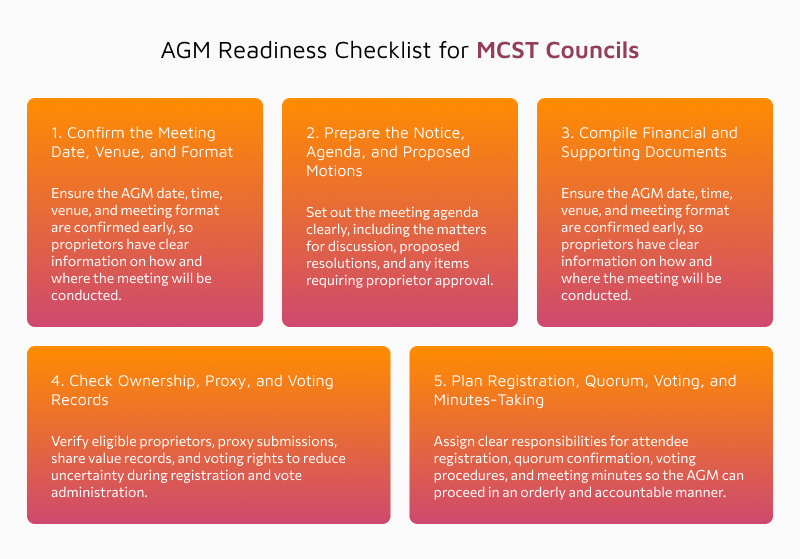
Pre-meeting preparation usually begins several weeks before the AGM. The council and administrative team prepare the financial statements, agenda, supporting materials, ownership records, and voting information for proprietors to review.
Financial statements should provide proprietors with a clear view of operating fund expenditures, sinking fund balances, contractor payments, and other maintenance costs. The agenda should also set out the sequence of discussions, proposed resolutions, matters related to the council election, and explanatory notes where needed.
Accurate ownership records are equally important. They help confirm which subsidiary proprietors are eligible to attend, appoint proxies, or vote. This is especially relevant where units have changed hands, company-owned units require authorised representatives, or voting rights are tied to share value.
Managing Proxy Representation
Proprietors who are unable to attend the AGM may appoint a proxy to participate on their behalf. This allows owners to remain represented if they are overseas, unavailable due to work, or unable to attend physically.
Before the meeting, proxy submissions are reviewed to confirm that all required information has been properly completed and that the appointment is valid. Under Singapore strata guidance, the proxy appointment must be made in writing. Where the owner is a company, the appointment is to be executed under seal or under the hand of an authorised officer or attorney.
Careful proxy review is therefore an important part of responsible property and estate management, particularly for larger developments with many absentee owners or company-owned units.
Meeting Day Procedures: Conducting the AGM
Meeting day procedures focus on registration, quorum confirmation, report presentation, discussion, council elections, and voting. Attendees should be registered so their eligibility can be confirmed before the meeting proceeds.
Once a quorum is confirmed, the meeting may move through the agenda. Audited accounts, estate updates, maintenance priorities, and council matters can then be presented clearly, giving proprietors a fair opportunity to ask questions.
Council elections are also conducted during the AGM, where applicable. These appointments matter because council members help guide budgeting, maintenance priorities, contractor oversight, compliance matters, and communication with proprietors after the meeting.
Managing Voting and Resolution Outcomes
Voting procedures determine whether proposed resolutions are adopted by the proprietors participating in the meeting. Depending on the motion, voting outcomes may need to reflect the relevant resolution type, vote count, poll requirement, or share value basis.
This illustrates why AGM procedures require more than basic meeting coordination. They require a clear understanding of the estate’s records, the nature of each motion, and the proper method for recording the outcome. In larger or more complex developments, experienced managing agent services can support accurate vote administration, reliable records, and a smoother decision-making process without turning the AGM into a purely procedural exercise.
At Newman SRE, this process can also be supported through an AGM module within FMdash, where technology is used to trace AGM progress, manage key records, and assist the MCST in conducting a smoother AGM.
Post-Meeting Governance Follow-Up
The work does not end once the meeting closes. After the AGM, the council and administrative team must ensure that decisions are recorded, council appointments are confirmed, and approved actions are properly followed through.
Preparing and Circulating Meeting Minutes
After the AGM concludes, a summary of the resolutions passed may be shared with residents or subsidiary proprietors to keep them informed about the key outcomes. The draft minutes are typically prepared and displayed on the notice board as draft records, rather than circulated as final minutes immediately. These minutes should then be adopted as a motion at the subsequent AGM.
For an MCST annual general meeting, the minutes should be clear enough for owners to understand the key decisions without having to interpret vague or incomplete notes. This supports transparency and reduces the risk of later disagreement over what was discussed or approved.
Confirming Council Appointments and Implementing Decisions
Where council elections have taken place, the newly elected council members are usually reflected in the AGM summary of resolutions, with the relevant names submitted to BCA for recording purposes. This helps clarify who may act on behalf of the MCST after the AGM and reduces uncertainty during the transition into the new council term.
Once the annual budget is approved, it gives the council a clearer basis for managing estate funds, planning maintenance priorities, and carrying out approved works. Resolutions relating to maintenance, estate improvements, managing agent appointments, or auditor appointments also help set the priorities that will shape estate operations moving forward. At this stage, AGM procedures should not end with the meeting itself. The AGM should also address the appointment of the managing agent and auditor, and the resolution may empower the incoming council to appoint the managing agent for the new term. Follow-up after the meeting may include recording council decisions, communicating key outcomes to residents, coordinating service arrangements, and planning estate matters according to the resolutions passed.
In Singapore’s strata environment, disciplined follow-up is especially valuable because estates often involve many stakeholders with different expectations. Clear administration of strata management meetings, proper documentation, and timely follow-up help maintain confidence in the MCST’s decision-making process.
Professional Coordination of AGM Procedures
Professional coordination helps an AGM move from a statutory requirement to a well-managed governance exercise. For MCST councils, the value lies not only in meeting formal obligations but also in making sure owners receive clear information, meeting records are accurate, and decisions can be acted on after the session ends.
Managing Meeting Logistics and Stakeholder Communication
AGM coordination also depends on clear communication before, during, and after the meeting. In Singapore condominiums, proprietors may include resident owners, landlords, overseas owners, corporate owners, and investors, so notices, attendance instructions, registration processes, and follow-up communication should be easy to understand.
During the meeting, discussions should remain orderly while still allowing proprietors to raise questions about estate management. For councils working with a managing agent in Singapore, this coordination can also help align meeting administration with wider estate operations and owner concerns.
How Newman SRE Supports Councils in Managing AGM Procedures
For MCST councils, professional support is most valuable when it connects the meeting process with the practical realities of running an estate. Newman SRE’s support is designed to reduce practical risks in AGM procedures, such as missed preparation timelines, incomplete proxy records, unclear voting documentation, late circulation of supporting materials, and weak post-meeting follow-up.
Newman SRE supports MCST councils by providing managing agent support throughout the AGM process, from preparation to post-meeting documentation. Where appropriate, internal workflow systems such as FMdash can support AGM timeline tracking, document control, templates, SOPs, digital records, and follow-up visibility.
This support is practical because AGM decisions often lead directly into estate work after the meeting. Newman SRE can help councils connect approved budgets, maintenance priorities, service follow-up, and resident communication with the meeting records that support them. This is especially relevant to estate management in Singapore, where AGM procedures should support both formal meeting compliance and practical follow-through. With access to integrated facilities management support, the team can also help councils coordinate operational next steps rather than treating the AGM as a standalone event.
Questions You Might Ask
1. What support does Newman SRE provide when coordinating AGM procedures?
Recognising the complexity involved in organising an AGM, Newman SRE uses structured workflows and digital support tools, including FMdash where appropriate, to support property managers and their teams. These tools can assist with timeline tracking, document control, process guidance, templates, SOPs, digital documentation, and record visibility. This helps councils maintain better traceability and administrative clarity throughout the AGM process.
2. Can proprietors appoint proxies to attend the AGM on their behalf?
Yes. Proxy representation allows proprietors who are unable to attend the meeting to appoint another individual to vote on their behalf. As part of proper AGM procedures, the proxy appointment must usually be submitted using the prescribed form within the required timeframe so that the representation can be properly recorded before the meeting begins.
3. What decisions are typically made during an AGM?
Common decisions include approval of financial statements, adoption of annual budgets, election of council members, and voting on resolutions affecting estate management. These decisions guide the estate’s financial planning, operational priorities, and governance structure for the upcoming year.
4. Why do many estates appoint managing agents to coordinate AGM procedures?
Professional managing agents such as Newman SRE assist councils with administrative coordination so that AGM procedures are carried out in an organised and compliant manner. Their support helps ensure that documentation, meeting logistics, and voting processes are managed systematically throughout the AGM process. This is valuable where the estate needs dependable governance support before, during, and after the meeting, rather than ad hoc assistance limited to the meeting day.
5. How can proprietors prepare before attending an AGM?
Proprietors can prepare by reviewing the meeting notice and supporting documents distributed before the AGM, particularly the financial statements and proposed agenda items. This helps them understand the AGM procedures before the meeting, raise informed questions, and participate more effectively in discussions during the session.
Conclusion

The Annual General Meeting plays a central role in condominium governance by providing a formal platform for financial review, council elections, and operational decision-making. For MCST councils, it is an important opportunity to account for the past year, outline upcoming priorities, and involve subsidiary proprietors in matters affecting the shared estate.
Because AGM procedures involve statutory requirements and detailed administrative coordination, careful preparation is essential. Notices, agendas, financial statements, proxy records, quorum checks, voting processes, and meeting minutes all need to be handled clearly so that decisions can be properly recorded and followed through.
Through professional coordination and administrative support, firms such as Newman SRE help MCST councils manage AGM procedures with clarity and organisation, especially where councils need to coordinate meeting documentation, attendance, voting, proprietor communication, and post-meeting follow-up.
For councils preparing for upcoming Annual General Meetings, Newman SRE can support meeting preparation, documentation, procedural coordination, and post-meeting follow-up. Speak with our team to discuss how your council can conduct AGMs with greater clarity, confidence, and continuity.
